Customer expectations are increasing day-by-day. Whether it’s a broadband user experiencing downtime or a mobile subscriber upgrading their plan, customers expect seamless, personalized and fast service. For telecom providers using a CRM Software becomes essential.
Below are the must-have CRM features every telecom service provider should implement to stay competitive and customer-focused.
Telecom providers manage millions of customer interactions across multiple touchpoints—calls, emails, chats, apps and in-store visits. A powerful CRM must offer a unified 360-degree customer view that includes:
This comprehensive visibility enables agents to resolve issues faster and deliver personalized service.
Customers connect through various channels—phone, social media, live chat, email and messaging apps. Your CRM should:
Omnichannel capabilities ensure consistent customer experiences, regardless of how customers reach out.
Service disruptions and technical issues are common in telecom. A CRM must provide:
Automation reduces resolution time and improves customer satisfaction.
Telecom businesses operate on complex billing models—prepaid, postpaid, bundled services and usage-based pricing. CRM systems should integrate with billing platforms to:
Seamless billing integration reduces disputes and increases transparency.
Telecom providers constantly acquire new customers through online campaigns, retail stores and partner channels. CRM tools should:
Efficient lead management helps increase customer acquisition rates while reducing sales cycle time.
Churn is one of the biggest challenges in telecom. Advanced CRM systems offer:
By identifying early warning signs, providers can proactively engage customers before they switch to competitors.
Manual processes slow down operations. CRM automation can streamline:
Automation improves operational efficiency and reduces human error.
Telecom services often require on-site installations and repairs. A CRM should support:
This ensures faster installations and improved service reliability.
Data-driven decisions are crucial. CRM platforms must provide:
These insights help leadership teams make strategic decisions.
Telecom companies grow rapidly through expansion and mergers. A CRM must:
Flexibility ensures long-term ROI and future-proof operations.
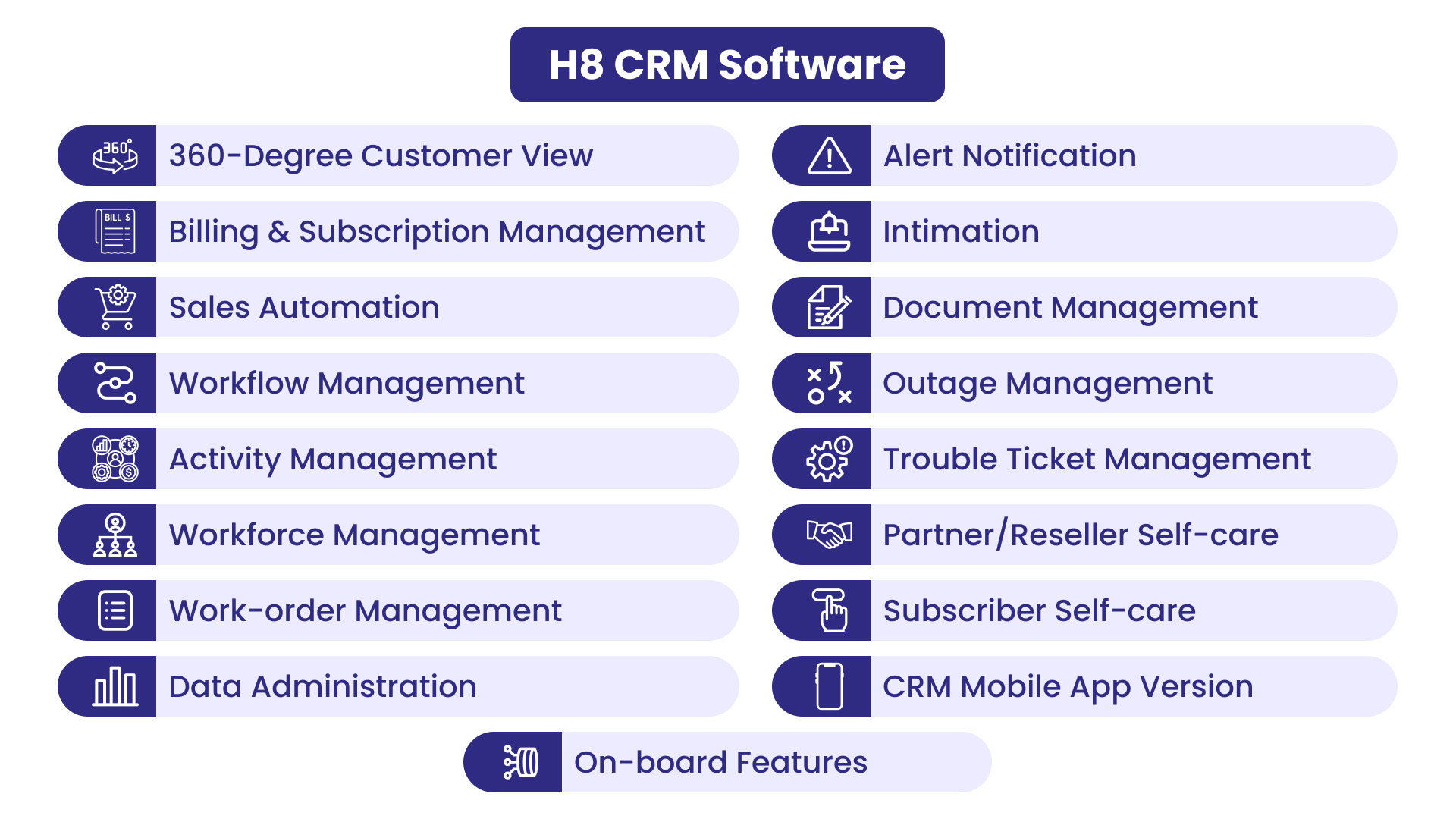
In the telecom industry, customer experience is the ultimate differentiator. A robust CRM system is not just a database—it’s a strategic growth engine. H8 CRM Software comes with various features like omnichannel support, automation, analytics, churn prediction & much more, telecom providers can enhance customer satisfaction, reduce operational costs and drive revenue growth.
Investing in the right CRM platform today ensures your telecom business remains agile, competitive and customer-centric in the years ahead.
Have any questions or want to have a demo of H8 CRM Software? Contact us right now! Write us a mail at h8ssrms@height8tech.com or call us on +91-079-40089216.
Follow us on Facebook, LinkedIn, Twitter and YouTube to get updates on the latest technological advancements in the telecom sector.